In the service industry, as in many other fields, customer satisfaction plays a crucial role. Not only does the ability to provide quality service matter greatly, but so does the skill of communicating with people. Sometimes you encounter not-so-pleasant personalities. Working with them is challenging, but possible.
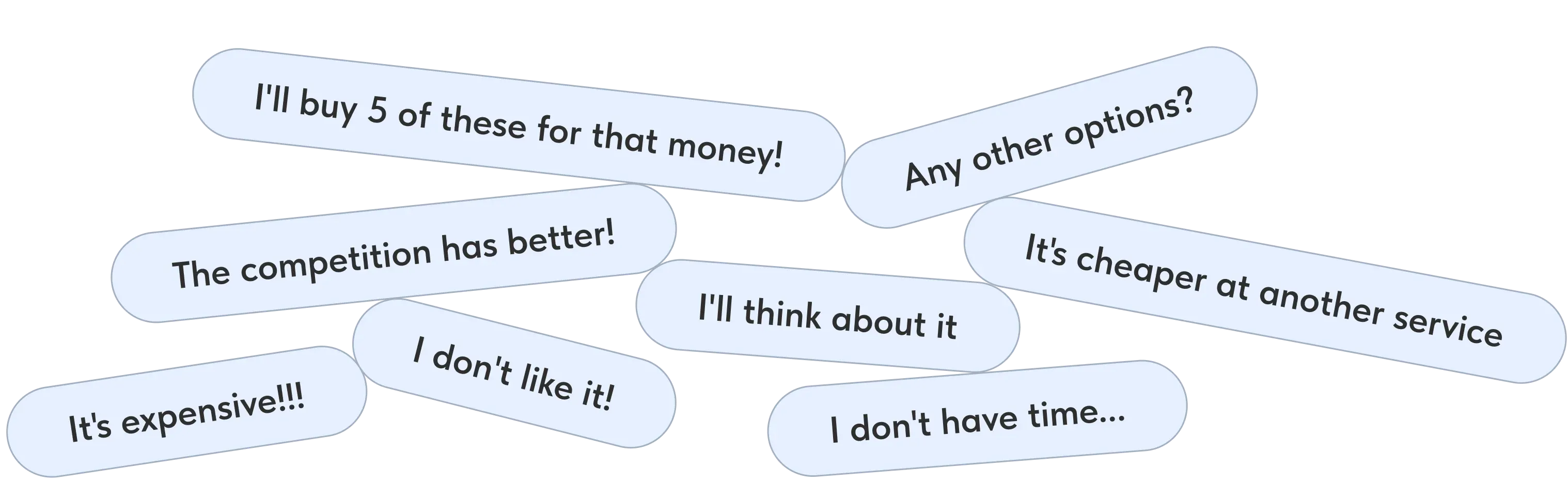
In this checklist, we've gathered 5 main objections from clients that service business owners face, and we'll explain how to handle them.
Objection #1
– IT'S TOO EXPENSIVE!
Clients aren't always satisfied with the established price for the service they need, which may cause them to leave and look for cheaper options. What to do in such a situation?
Solution:
Clarify what the client is comparing the price to. They might have seen other options from your competitors. Explain that cheaper doesn't always mean better quality.
Find out how much they expect to spend. Offer to suggest a cheaper alternative that doesn't compromise on quality.
Explain that the price justifies the quality of the service or product. Offer a complimentary accessory or additional free service.
Installment payments. Split the amount over several months, making it less "painful."
If it's about retail sales, suggest a trial order of a small batch (a few items).
Example:
Client:
Are you kidding me? Why such a price tag? I've seen prices at other service centers, they're much cheaper there.
Employee:
We've been in the market for over 10 years and use only quality materials. We provide a 90-day warranty on every repair. Which service centers did you see lower prices at, could you please specify?
Client:
That's all great, of course, but across the street the same service costs half as much. They've also been in the market for a long time, use quality parts, and offer warranty. What's the difference then?
Employee:
Yes, it's cheaper there, but they use Chinese parts and then refuse warranty repairs. Do you want to visit repair shops every 3 months? I can offer you any accessory worth up to $1000 as a gift.
Client:
No, thank you. I'm not ready to spend that much money on phone repair.
Employee:
Since it's your first time with us, I can offer you a 20% discount on the repair.
Objection #2
– I'LL THINK ABOUT IT...
Sometimes clients delay decisions to weigh the pros and cons. But this often hides doubt or fear. What to do?
Solution:
Ask the client what specifically concerns them, what's stopping them from making the purchase.
"Please note that..." Mention the advantages of the chosen service or product: tell them how many satisfied customers have already chosen you.
Point out the limited nature of the offer, for example: "This offer is valid for only 1-2 more days. After that, prices will increase." This approach encourages the client to take action 🙌
Example:
Client:
I'll go look around some more, check things out, think about it.
Employee:
In this shopping center, we're the only ones selling this particular model. In other places, it will cost significantly more.
Client:
Thank you, if anything, I'll come back to you
Employee:
In a few days, we'll have a price increase. We haven't advertised this anywhere yet. If I were you, I'd buy now to avoid spending more money later.
Objection #3
– THE COMPETITION IS BETTER AND CHEAPER!
Clients often compare offers from different companies, trying to choose the best price-quality ratio. What to do when they mention competitors?
Solution:
Find out which competitors they're comparing you with and analyze their offer.
Explain the difference in the service provided and talk about your advantages.
Explain why your prices differ slightly from competitors' prices: quality of materials used, longer warranty period.
Objection #4
– I DON'T LIKE THIS!!!
Sometimes clients remain dissatisfied with an offer even if it meets their requirements. This might be related to personal preferences. How to respond?
Solution:
Thank the client for their honesty. Ask what specifically they don't like?
Ask what option would satisfy the client and why.
Find out what the client pays attention to when choosing a product or service.
Offer an alternative and make a comparison. Point out the advantages of your option.
Example:
Client:
I'm satisfied with everything about this laptop, except that it's heavy. All other models don't meet my specifications.
Employee:
Yes, it is indeed heavier compared to other models. But you'll be able to work on it for up to 26 hours without connecting to power. There's an ultrabook at the same price, but it has a worse screen and less RAM. It weighs about 1 kg, but you'll only be able to work on it without power for about 8 hours. I'd recommend going with the first model - it's more practical.
Client:
I'll look around some more. Maybe I'll find something more suitable.
Employee:
This is the last remaining laptop of this model. We received 20 units 2 weeks ago, and they've all been sold out.
Objection #5
– I DON'T HAVE TIME!
Some clients postpone purchases or orders due to lack of time. This is especially relevant for services that require paperwork or waiting.
Solution:
Convince the client that placing an order will take minimal time - for example, 5 minutes.
If it's about service completion time, ask what timeframe would work for them. Offer to categorize their order as "Urgent."
Offer free delivery so the client doesn't have to spend time traveling to you.
Example:
Client:
Wait 5 days? My work will come to a standstill. I need it by tomorrow.
Employee:
I checked with the technician. We can take your device and do an urgent repair. It will be ready by tomorrow afternoon. Would you like us to arrange delivery to your home or office?
Client:
Let's do the office
Employee:
Perfect! Please provide the address.
Extreme Case
– I'LL KILL YOU!
You've encountered a client of extreme irrationality. Yes, those exist too.
Solution:
Don't panic :) Call the police
Instead of thousands of examples:
To Summarize
Working with "difficult" clients requires patience, flexibility, and a competent approach. View objections as opportunities to better understand client needs and demonstrate the value of your services. Listen to the client and show care. You'll find that even the most difficult clients can become good and loyal ones.
And if it gets really tough - remember: even the most demanding clients won't resist your service and a small bonus.
Don't forget to monitor your online presence
93% of users search for information about products and services nearby.
76% of users trust reviews as much as recommendations from friends.
If your company is absent from geo-services, you're simply losing a large share of potential clients.
How to start getting good reviews?
Use the HelloClient review widget. Intercept negative reviews - they'll go to your personal account. All positive reviews will be sent to online maps like Yandex, Google, and 2GIS.